Companion Plants for Hostas in Dry Colorado Shade
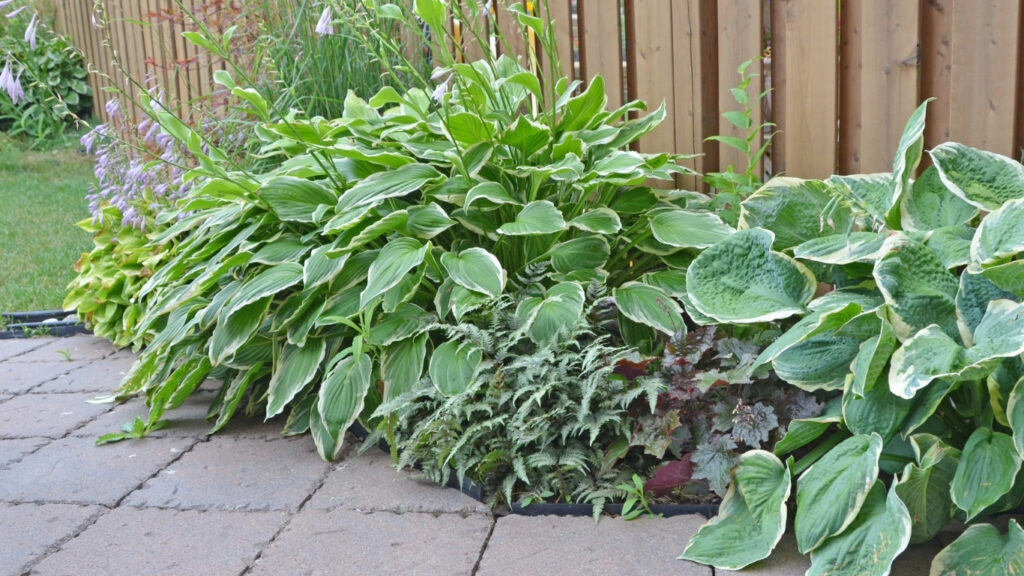
One hosta on its own is a specimen. Two or three plants of different leaf shape around it become a planting, and that is where most Front Range yards run into trouble, because the shadiest ground is also the driest: under a mature tree, along the north wall of the house, in the narrow side yard the sprinklers never quite reach. Siting and soil preparation are covered in the Colorado shade gardening guides. What follows is about the plants that go in next to the hosta.
What Dry Shade Means on the Front Range
Under a mature tree the canopy blocks rain along with sun, and the roots take whatever soil moisture does arrive. The north side of a house or garage stays cool and dim while sitting in a rain shadow cast by the roofline. Side yards and the strips between a fence and a wall are dry for a duller reason, which is that nobody ever aimed a sprinkler head there and the hose does not reach that far.
Precipitation here is low to begin with. Much of the soil is alkaline clay that sheds water once it dries out and drains poorly when it is wet, and the air pulls moisture from leaves faster than eastern air does. A spot that would be merely shady in Ohio is shady and parched here.
How Much Water the Bed Will Need
Lady’s mantle, sweet woodruff, and coralbells hold up in Colorado’s semi-arid conditions. Hostas, ferns, astilbe, Japanese anemone, and foxglove want more moisture than that, which is worth knowing before you buy anything. A hosta is not a dry shade plant. It is a shade plant that will live in a dry shade location if you commit to watering it.
You can water the bed as a unit and pick companions that will accept the same inch or so a week. Or you can keep the hostas in a smaller irrigated pocket and use genuinely drought tolerant plants across the rest of the area. Putting a thirsty plant and a xeric plant on the same drip line generally leaves one of them unhappy.
Companions That Handle Colorado Shade
Coralbells (Heuchera) form low mounds of rounded, often ruffled leaves, and the foliage color range is the widest of anything here, running from lime through amber to near black. It is one of the few shade perennials that genuinely suits semi-arid conditions. The flowers are small and carried on thin stems well above the leaves.
Lady’s mantle (Alchemilla) has soft, pleated, gray green leaves that catch water in beads after rain, with loose sprays of tiny chartreuse flowers. It handles the same dry conditions.
Lungwort (Pulmonaria) belongs with hosta and dead nettle among the foliage plants whose speckling and striping reads well in low light. The silver spotted leaves do the work, and it is one of the earliest shade perennials to flower in spring.
Ferns sit in the moisture loving group alongside hostas, which makes them the obvious partner if you are already irrigating. Upright, finely divided fronds are the strongest texture contrast available to a broad hosta leaf.
Bergenia carries large, glossy, leathery leaves that take on bronze and red tones in cold weather, so the bed keeps something to look at after the hostas have collapsed for the year.
Astilbe belongs to the moisture group as well, and its ferny foliage and upright plumes work in the same wetter pocket.
Groundcovers to Fill the Space Between
Sweet woodruff (Galium odoratum) makes deep green whorls of leaves with starry white flowers from April well into June. It is not evergreen, but it tolerates dry conditions, so it works toward the drier end of a bed.
Dead nettle (Lamium maculatum) holds variegated foliage through spring, summer, and fall, with pink or white flowers, and it is easy to find at any garden center.
Bugleweed (Ajuga reptans) spreads fast into a mat, with foliage that runs from tricolor to deep purple depending on variety. It does best with a few hours of direct sun in the early morning or late afternoon.
Creeping Oregon grape (Berberis repens, formerly Mahonia repens) is a woody evergreen with spiny, holly like leaves that turn reddish in winter, sulphur yellow flowers in spring, and blue fruit in summer. It gives a shade bed year round structure that herbaceous plants cannot.
Periwinkle (Vinca minor) has leathery evergreen leaves and violet blue flowers. It spreads by trailing shoots that root wherever a leaf node touches soil, so plant it where a walk, a wall, or an edging will stop it.
Pairing by Leaf Rather Than Flower
Bloom in a shade bed is brief and mostly small. The foliage is there from May through October, so a shade garden runs on how the leaves are combined and contrasted, by form, by texture, and by color.
A hosta leaf is broad and flat, so whatever sits next to it should not be. The finely cut fronds of a fern, the narrow whorls of sweet woodruff, or the small ruffled rounds of a coralbell all give the eye somewhere to go. Then look at color. A blue hosta beside lime green lady’s mantle reads clearly from across the yard, while two medium green plants next to each other blur together.
Surface finish is the piece most people skip. Bergenia is glossy, lungwort is matte and spotted, lady’s mantle is soft enough to hold water droplets. A glossy leaf next to a matte one makes both look better than either does alone.
Planting Around Mature Tree Roots
Tree roots typically extend well past the dripline, two to five times the width of the crown, and most of them sit in the top 36 inches of soil. Under a mature tree you are planting into an occupied root zone rather than open ground, and the tree was there first.
Turning or removing soil around an established tree exposes and injures roots and changes the conditions those roots have adapted to, so do not till. Dig individual planting holes instead and work between roots rather than through them. If you hit a root thicker than an inch or two, move the hole.
Spreading six inches of imported topsoil over a root zone to build a tidy bed is one of the more common ways a healthy tree gets damaged in a Denver yard. Amend the individual holes if the soil is poor, and leave the existing grade where it is.
Two to three inches of shredded bark or shredded leaves over the bed holds moisture, steadies soil temperature, and keeps out the turf that would otherwise compete with the tree and the perennials both. Pull it back from plant crowns and keep it off the trunk.
Combinations You Can Copy
Under a mature shade tree, in the part of the bed you are willing to irrigate: a blue hosta such as ‘Halcyon’, three or four ferns set behind it, and sweet woodruff running underneath. Space the hosta and the ferns about two feet apart and let the woodruff close the gaps on its own over two seasons.
For a narrow bed on the north side of a house, run coralbells along the front edge, a green or gold hosta behind them, and lungwort at the ends where the light drops off. Eighteen inches to two feet of spacing is enough, since none of the three makes a large clump.
For a dry corner you would rather not irrigate much, use creeping Oregon grape as the backbone with lady’s mantle in front of it. Add one hosta in a hand watered pocket if you want it. This is the version that still looks reasonable after two weeks away in July.
Most failures in these beds trace back to water rather than plant choice. Decide how much of the area you are actually willing to irrigate before you buy anything, and the plant list follows from that.